AI Agent Spend Needs Runtime Guardrails
A new Menlo Ventures report estimates that enterprise AI spending reached $176.8 billion by September—and that surveyed companies spent well beyond plan. The useful signal is not the market-size headline. It is that agent costs can grow while people are offline, making annual budgets and per-seat controls too slow. Operators need runtime limits tied to workflows and accepted work.
Key Takeaways
- Menlo estimates AI deployment spending grew 5.4 times year over year.
- Average spending overshot plan far more than median spending.
- Agent loops require runtime limits, not invoice-stage review.
- Operator posture: ask sharper vendor questions about cost enforcement.
What does the new spending report actually show?
Menlo’s 2026 State of Enterprise AI report estimates deployment spending rose from $33 billion in 2025 to $176.8 billion by September 2026. Its survey found average company spending reached 4.7 times the prior year’s level against a planned 1.9 times—about 2.5 times plan. The median moved less dramatically: 2.2 times the prior year against a planned 1.8 times.
That average-median gap matters. A smaller group of heavy users appears to account for disproportionate growth, so the headline does not mean every company should multiply its budget. Menlo says the study was fielded by Morning Consult from September 8–26 among nearly 400 U.S. enterprise decision-makers responsible for more than $4 billion in AI spending. The $176.8 billion figure is Menlo’s market estimate, not an audited total, and Menlo invests in several companies discussed in the report.
The report attributes much of the gap to agents that run in parallel and continue consuming models without continuous user input. That explanation is plausible, but it is still Menlo’s interpretation—not proof that agent spending produced proportional business value.
Why do agents change budget controls?
Seat budgets assume a person initiates most consumption. Agentic workflows can multiply calls through planning, tool use, retries, delegated workers, and long context. A monthly dashboard may identify the problem only after the spend has happened.
The FinOps Foundation’s AI guidance recommends watching for agent loops, prompt changes, and model switches while monitoring tokens per minute at the application level. That complements the accepted-output discipline in our coverage of agent token costs and shared AI workflow budgets: consumption is an input; useful completed work is the outcome.
Provider controls also have boundaries. OpenAI says spend alerts do not stop API traffic, while hard limits can stop affected requests. Anthropic’s Usage and Cost API supports workspace attribution and budget monitoring, but customers still need their own workflow-level controls and response plan.
What should operators do now?
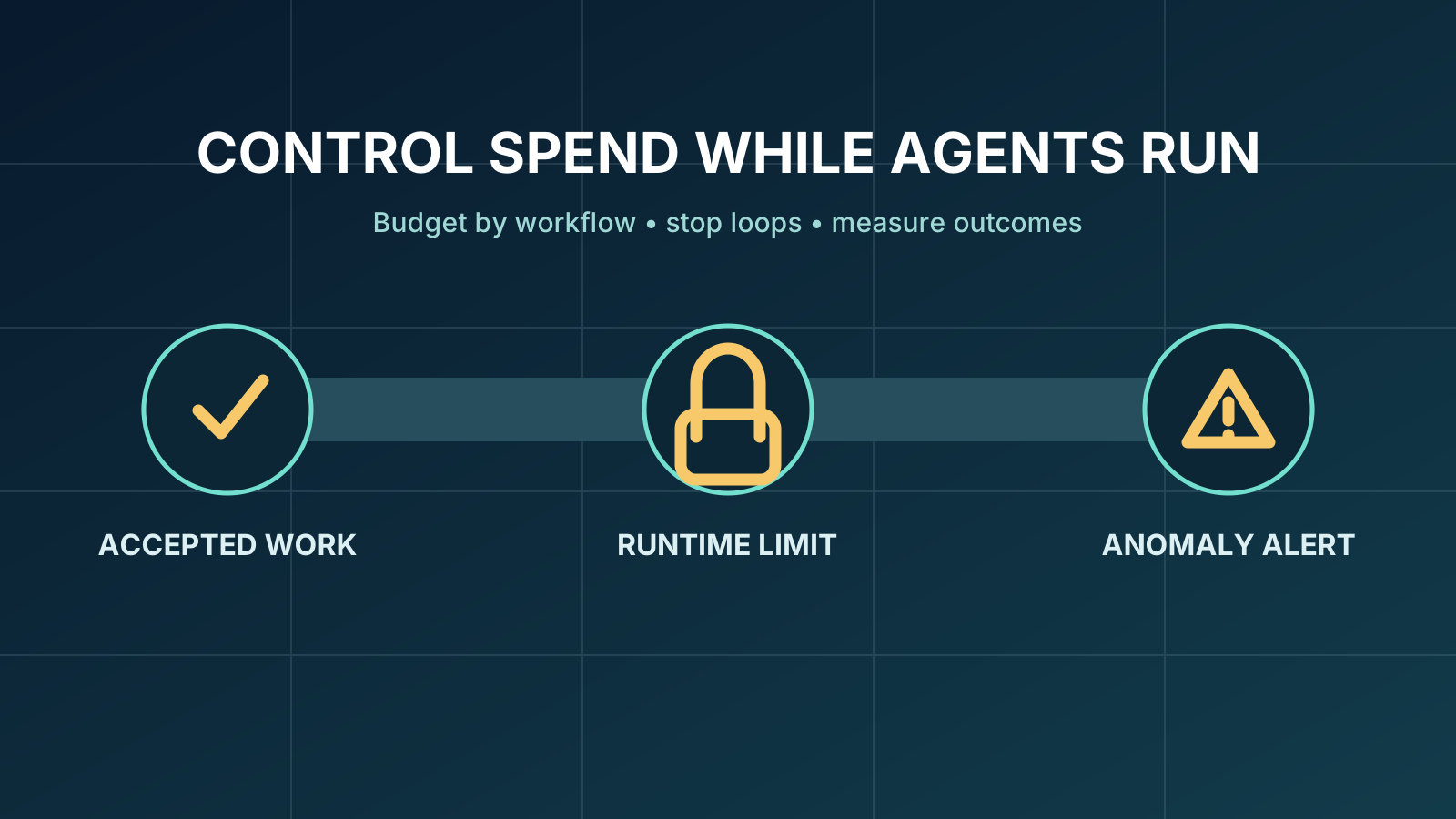
Ask sharper vendor questions, then test controls on one metered workflow. Require a business owner, technical owner, cost center, per-run ceiling for steps, tokens, time, and tool charges, plus a daily anomaly threshold and an automatic pause or downgrade path.
Review weekly spend alongside accepted outputs, retries, reviewer minutes, failures, and business results. Separate sandbox, production, and background-agent usage so experiments cannot silently consume operating budgets. Test whether a hard limit actually stops work, what happens to in-flight tasks, and how safely the workflow resumes.
Watch next for named enterprises reconciling agent spend with accepted work, stronger provider-side per-run controls, and independent evidence behind Menlo’s market estimate. Until then, do not raise budgets merely because the category is growing.
FAQs
Does the report prove enterprises are overspending on AI?
No. It shows reported spending exceeded plans; it does not establish whether the additional spend created sufficient value.
Are monthly spend alerts enough?
No. Alerts help, but autonomous workflows also need per-run ceilings, anomaly detection, and a tested stop path.
Should operators cut agent budgets now?
Not automatically. Keep productive workflows funded, but require cost attribution and accepted-output evidence before expanding limits.