ChatGPT’s Tab Merge Changes the Rollout Test
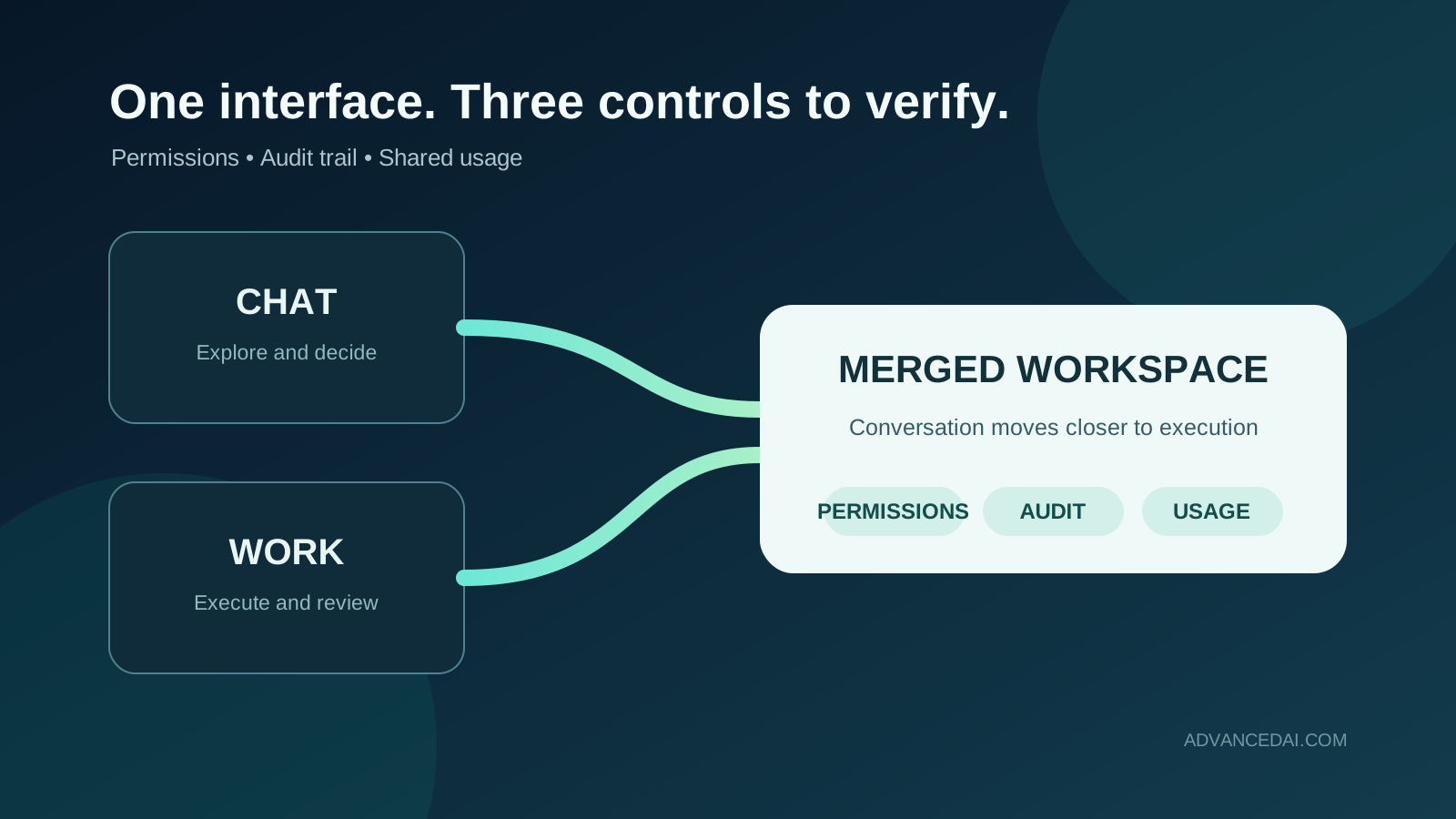
OpenAI plans to merge ChatGPT’s Chat and Work tabs for select users before a wider rollout, while keeping Codex visually separate. The important operator change is not the cleaner interface. It is that exploration and multi-step execution will sit closer together, while ChatGPT and Codex draw from one usage allowance. Test the boundary before expanding access.
Key Takeaways
- The Chat and Work merge is planned, not broadly deployed.
- Codex stays separate, but both products will share a usage pool.
- A simpler interface can make execution easier to start—and harder to notice.
- Operator posture: run a small test before changing access or budgets.
What changes in the ChatGPT tab merge?
As of November 2, according to an email reported by TechCrunch, OpenAI plans to let users move from discussing an idea to having ChatGPT execute it in one place, using files and plugins to create presentations, websites, or web-based actions. The experience will reach select users for feedback first. The Verge reported that an OpenAI employee said it is not rolling out yet.
Codex will remain a separate desktop experience. However, TechCrunch says the email also states that ChatGPT and Codex will consume one allowance pool and that some users may reach resets sooner depending on model and usage. OpenAI’s current usage guidance is therefore part of the deployment question, not a footnote.
This is an interface and metering change around capabilities OpenAI previously introduced with ChatGPT Work. It is not evidence that new permissions, stronger controls, or cheaper completed work have arrived.
Why does one interface alter the operator risk?
Separate tabs provide a visible cue: conversation happens here; task execution happens there. Removing that cue can reduce user friction, but it may also blur when a request begins using connected files, plugins, web actions, or a shared allowance.
That does not make the design unsafe. It makes defaults and prompts more important. Administrators should verify whether the merged experience preserves workspace restrictions, action approvals, connector controls, and audit events described in OpenAI’s enterprise privacy commitments. Do not assume an unchanged back end simply because the new front end looks simpler.
The cost question also shifts from “Which product did employees use?” to “Which accepted work consumed the shared pool?” That is the same discipline AdvancedAI recommended for agent token costs and OpenAI’s broader superapp direction.
How should a business test the merged experience?
Run a small test with a limited user group and low-risk workflows. Before access changes, record current connector permissions, approval prompts, audit events, and weekly usage. Then measure completed tasks, shared-pool depletion, reviewer time, unintended tool use, and failures requiring escalation.
Ask OpenAI whether admins can distinguish Chat, Work, and Codex activity after the merge; whether connector and action policies remain unchanged; and whether budgets or alerts can be set by user, workspace, or workload. Keep consequential write actions behind human approval until logs show the intended controls survived the interface change.
Watch next for a documented rollout date, administrator release notes, audit-schema changes, and shared-allowance reporting. Until those appear, treat the merge as a pilot signal—not a reason to redesign governance.
FAQs
Is the Chat and Work merge available now?
Not broadly. OpenAI reportedly plans an initial release to select users for feedback before wider availability.
Will Codex disappear into ChatGPT?
No. OpenAI says Codex will remain a separate desktop experience, although it will share a usage allowance with ChatGPT.
Should companies expand ChatGPT Work access now?
Not because of this change alone. Pilot the merged experience, verify permissions and logs, and measure accepted work against the shared allowance first.