DeepSeek’s Alias Update Can Change Your Model Quietly
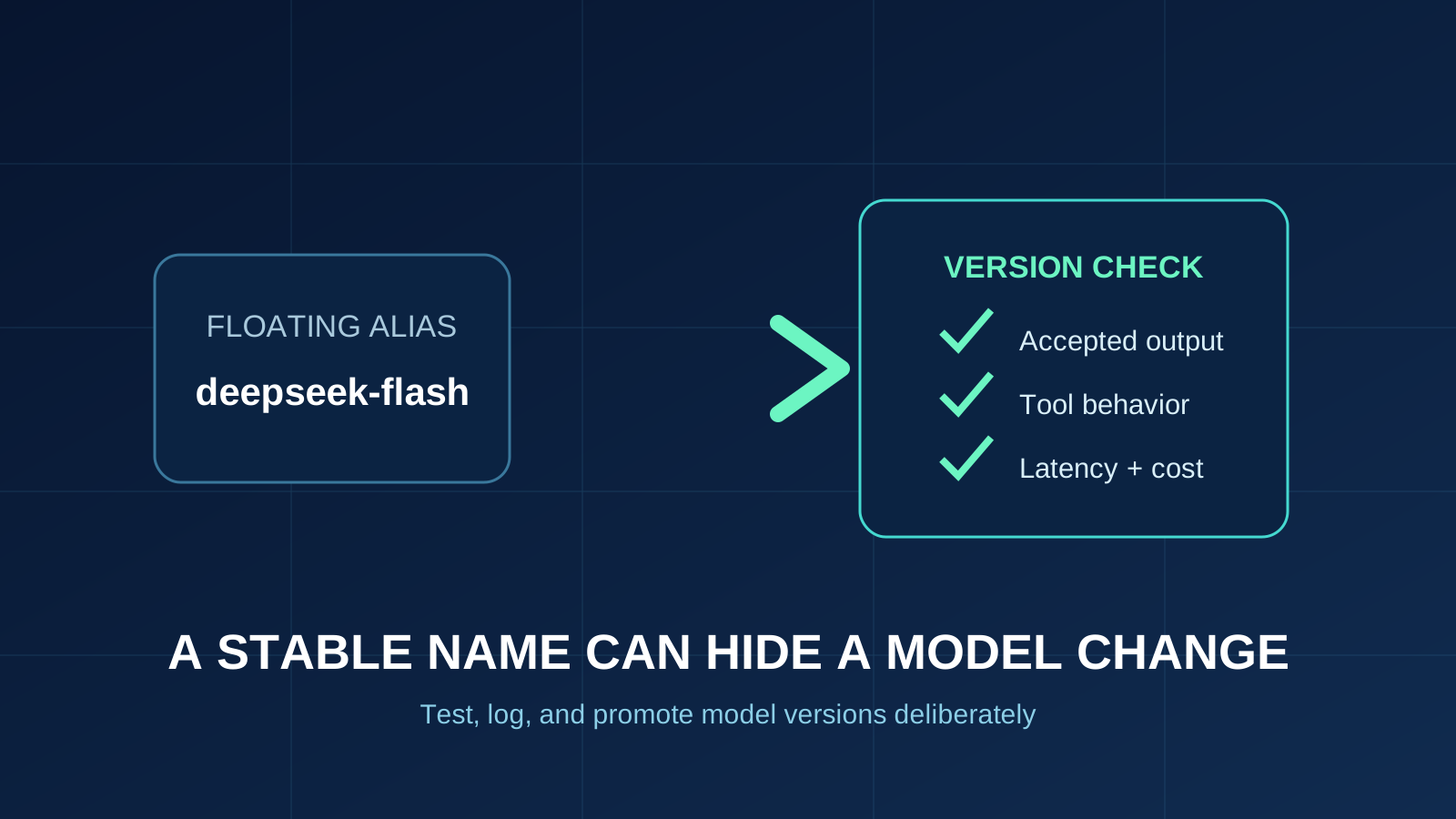
DeepSeek released V4.1 Flash 1017, but the operational issue is not its benchmark table. This alias update means DeepSeek now serves the new version when customers call the old Flash model names. If your workflow depends on stable output, latency, or tool behavior, run a small test now and pin an immutable version where your provider allows it.
Key Takeaways
- Legacy DeepSeek Flash names now route to V4.1 Flash 1017.
- Alias continuity does not guarantee behavior continuity.
- Search and Fetch billing begins November 1 Beijing time.
- Retest accepted outputs, tool calls, latency, and cost before scaling.
What changed in DeepSeek’s alias update?
On October 17, DeepSeek made V4.1 Flash 1017 live across its website, app, and API. The company describes stronger reasoning, coding, agentic, and visual results, plus shorter outputs and faster task completion. Those are vendor-reported launch claims, not independent production evidence.
The procurement detail is more important. DeepSeek’s current pricing page says the API model name remains deepseek-flash. It also says the retired names deepseek-v4-flash and deepseek-v4-flash-vision-exp are still accepted but now resolve to V4.1 Flash 1017 and receive current Flash pricing. A configuration file can therefore remain unchanged while the model behind it changes.
The direct API supports a one-million-token context window, thinking and non-thinking modes, tool calls, vision, and OpenAI- and Anthropic-format endpoints, according to the same pricing documentation. DeepSeek’s published peak rates are twice its off-peak rates, so a cost test must use the hours when production traffic will actually run.
Why does DeepSeek’s alias update matter to operators?
A model upgrade can improve headline scores while changing instruction adherence, output length, tool selection, JSON stability, or failure patterns. That matters most in automated workflows where a plausible but structurally different answer can pass through unnoticed.
DeepSeek’s open model card reports gains across its own benchmark suite, but it also says production users should rely on a maintained protocol-aware toolkit for prompt encoding. The separately published minimal inference code is explicitly a readable reference, not a production serving engine. Open weights do not remove integration, serving, or validation work.
This is the same budgeting discipline discussed in our agent-token cost briefing, with an added version-control problem. It also qualifies the control argument in our open-source AI coverage: downloadable weights increase options, but operational control still requires a production stack and a tested upgrade process.
What should a buyer test now?
Replay 20–50 representative tasks against the prior snapshot and V4.1 Flash 1017. Compare accepted-output rate, reviewer corrections, tool-call success, schema failures, elapsed time, output tokens, and total cost at peak and off-peak rates. Include long conversations and the exact system prompts used in production.
Inventory every integration that calls a floating alias. Where possible, separate evaluation from production and require an explicit promotion decision for model changes. If a provider exposes only a floating name, ask for advance-change notices, rollback options, and request-level version logs.
Also budget for tools. DeepSeek says Search and Fetch cost $0.75 per 1,000 successful calls, with currently free server-side calls in DeepSeek Harness, Claude Code, and Codex starting paid billing at 00:00 Beijing time on November 1. Watch the first invoices, independent reliability tests, and whether gateways expose immutable snapshots; OpenRouter currently lists a dated 1017 model identifier.
FAQs
Did DeepSeek discontinue the Flash API?
No. The deepseek-flash API name remains active, but DeepSeek says it now serves V4.1 Flash 1017.
Should teams migrate immediately?
Test first. Compare the new snapshot on representative, low-risk tasks before expanding or replacing a known production version.
Does an MIT license make self-hosting production-ready?
No. The weights are available under MIT, but serving, security, observability, upgrades, and validation remain the operator’s responsibility.