Google Adds Agent Spending Caps to Gemini Enterprise
Google Adds Agent Spending Caps to Gemini Enterprise
Gemini Enterprise adds pay-as-you-go and hard monthly agent spending caps. Here’s what Google’s pricing overhaul means for operators evaluating AI vendors.
By Advanced AI · September 3, 2026 · Industry News
Key takeaways:
- Google Gemini Enterprise now offers a pay-as-you-go edition with no required base subscription fee.
- Operators can set hard monthly spending caps for agentic workloads via Google Cloud’s billing console.
- Gemini 3.8 Flash launches at $0.75/M input and $3.75/M output — same price as 3.7 Flash, with better coding and reasoning performance.
- Before your next AI vendor renewal, request equivalent spending-control documentation from your current provider.
Google overhauled Gemini Enterprise pricing on September 2, 2026, adding a pay-as-you-go edition, monthly agent spending caps, and savings-plan discounts of up to 20%. Operators can now choose consumption billing and place project-level limits on agent workloads. The changes arrived alongside Gemini 3.8 Flash, Google’s third Flash model in six weeks.
What Does Gemini Enterprise’s Pay-As-You-Go Edition Actually Change?
The new pay-as-you-go edition adds consumption billing alongside Business, Standard, Plus, and Frontline editions. CNBC reported, citing Google-provided materials, that it includes savings-plan discounts of up to 20% and a zero-dollar base subscription option.
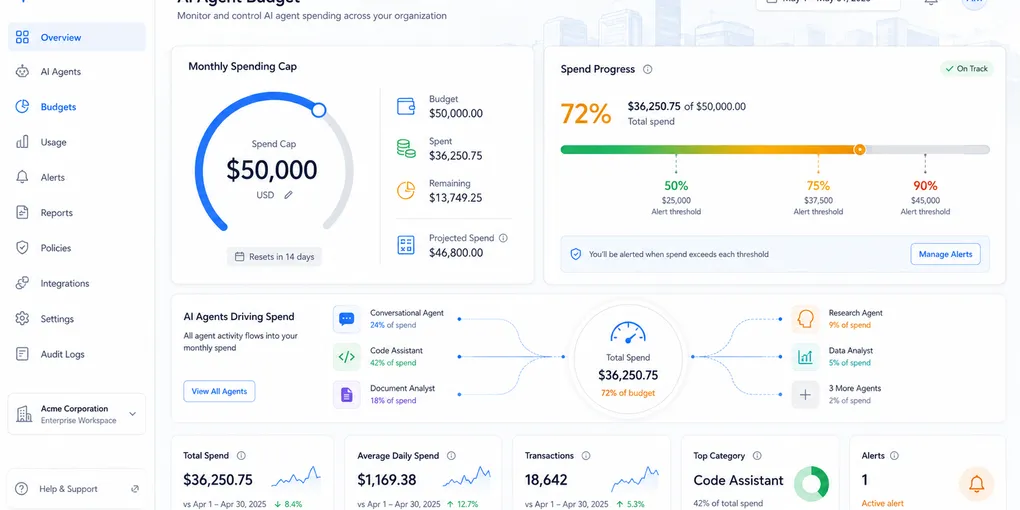
The governance addition matters more than the pricing model. Administrators can set project-level monthly spending caps and choose whether workloads pause or continue at standard rates after hitting the limit. That gives finance and IT teams a direct control for autonomous-agent deployments, where usage can be less predictable than ordinary employee chat.
What Does Gemini 3.8 Flash Deliver for Operators on the Model Side?
Gemini 3.8 Flash arrives at $0.75 per million input tokens and $3.75 per million output tokens — the same introductory price as 3.7 Flash — with Google claiming significant gains in software engineering, multi-step agentic tasks, and specialized domain reasoning. On the DeepSWE v1.1 long-horizon software engineering benchmark, Google says 3.8 Flash outperforms most larger frontier models at a fraction of their cost.
If your agentic workflows default to a premium model, Flash-class options now warrant a benchmark test on your actual tasks. Gemini 3.8 Flash Cyber, a cybersecurity variant, is launching through the Fairwind Program for trusted defenders; treat it as a watch item rather than a current procurement option.
What Should Operators Do Before Their Next AI Vendor Renewal?
Google is openly positioning this overhaul as a challenge to Microsoft Copilot’s seat-fee model and Anthropic’s pricing, per CNBC. That framing is Google’s marketing — but the spending-control question it raises is real regardless of which vendor you use.
Before your next renewal, map the workload profile and ask your vendor for project-level caps, pause-or-continue logic, and budget alerts. Fixed seats can fit steady usage; consumption pricing can fit irregular deployments. Missing controls are a governance gap worth pricing into the decision.
For operators, the near-term move is not a vendor migration. It is to enter your next AI renewal with a documented spending-control comparison. Watch whether Microsoft or Anthropic introduce equivalent hard-cap controls in response.
Frequently Asked Questions
What is the Gemini Enterprise pay-as-you-go edition?
Gemini Enterprise’s pay-as-you-go edition adds consumption billing with a zero-dollar base subscription option, according to CNBC’s report on Google-provided materials. Google Cloud documentation lists it alongside Business, Standard, Plus, and Frontline editions. It can suit irregular agent workloads that are difficult to map to fixed-seat allocations.
How do Gemini Enterprise’s agent spending caps work?
Administrators set project-level monthly spending caps through Google Cloud’s billing console. Once a cap is reached, operators choose whether workloads pause or continue at standard rates. The control gives finance and IT teams a clearer boundary for agent workloads with variable consumption.
Should operators switch from Microsoft Copilot or Anthropic to Gemini based on this?
Not on this announcement alone. Use it as a benchmarking trigger, not a migration mandate. Model your actual agent workload consumption, request equivalent spending-control documentation from your current vendor, and use both data sets in your next renewal negotiation. Test Gemini 3.8 Flash on your specific tasks before switching vendors.