McKinsey 2026: Why Only 6% of Companies Book AI Earnings
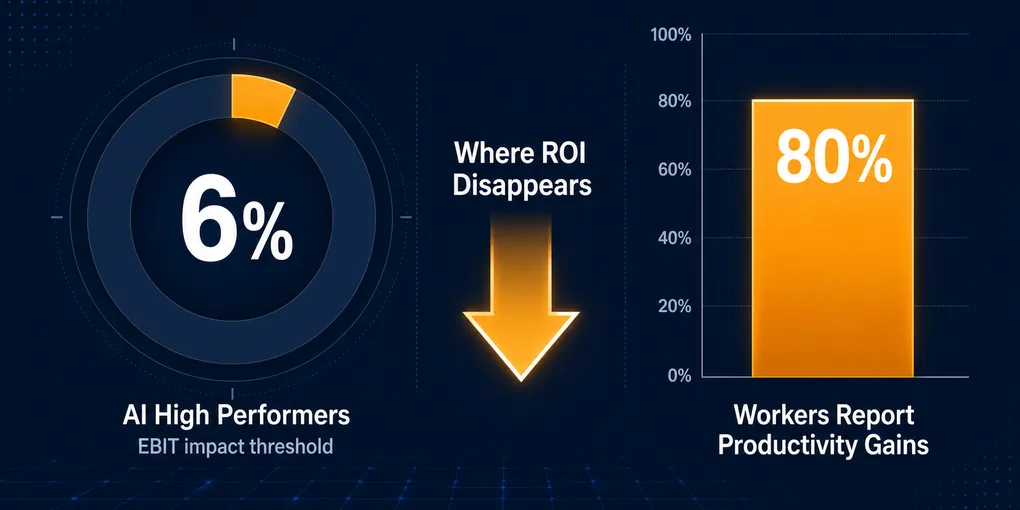
McKinsey’s 2026 State of AI survey, published August 25 by its QuantumBlack division, polled 1,719 executives across 97 nations (May–June 2026). Eighty percent of workers who use AI report improved personal productivity — yet McKinsey’s “AI high performer” classification (companies where respondents attribute at least 5% of EBIT to AI and call that impact significant) captures just 6% of respondents, flat from 2025.
Key takeaways:
- 80% of workers report AI productivity gains; only 6% of companies clear McKinsey’s ≥5% EBIT high-performer bar — flat from 2025.
- Only 37% of companies report any earnings impact from AI — the other 63% report none, per survey data.
- ~90% of function-level AI use cases remain in pilot mode, never scaled to production.
- High performers redesigned workflows at a 74% rate vs. 55% the year before — about 25% of other respondents redesigned at all.
- Posture: run a small test on one vertical workflow with an existing measurement baseline.
Why Don’t Individual Productivity Gains Show Up in Earnings?
AdvancedAI’s read of the data points to an architectural explanation. Horizontal tools — copilots, chatbots, writing assistants — are easy to deploy and genuinely improve individual efficiency. But their gains are diffuse: an employee who drafts emails faster is more productive, but unless that time converts into a measurable organizational output, the gain stays at the worker’s desk rather than flowing to the income statement.
Roughly 90% of function-level AI use cases — the vertical deployments that drive cost reductions and revenue — remain stuck in pilot mode. Most AI spending disappears in the gap between a successful demo and a production workflow with a measurable output.
McKinsey QuantumBlack senior fellow Michael Chui told The Register: “High performers are already seeing real ROI — but organizational change, not tool adoption, is the distinguishing factor.”
What Are the 6% of High Performers Doing Differently?
The distinguishing behavior is workflow redesign, not tool selection. In the 2026 survey, 74% of high performers fundamentally redesigned workflows (up from 55% the prior year), compared to roughly 25% of other respondents. Earnings impact concentrates in supply chain management, service operations, and manufacturing — contexts where AI does a bounded job against a measurable baseline — alongside revenue gains in marketing, sales, and product development.
The operator move: for each active AI deployment, ask whether AI is doing a bounded job with a defined output baseline. If the benefit is “people seem more productive” without a trackable unit, it’s producing worker satisfaction — not earnings-grade ROI.
Posture: run a small test on one process you already measure. See also: enterprise AI token costs before budgeting a vertical pilot, and Gartner’s $234B enterprise AI forecast for the broader spending context.
What Should Operators Watch Next?
The 6% high-performer share has been flat for two consecutive years while workflow-redesign adoption climbs (74% among high performers, up from 55%). Watch whether your own vertical pilot moves a measurable output by Q4 — that’s a direct signal, more useful than waiting for next year’s survey.
Also: 40% of large enterprises ($1B+ revenue) are now scaling agents in at least one function, up from 27% last year. If agentic scale is what finally moves the EBIT needle, you’ll see it in future survey data — but only if you’ve redesigned workflows around measurable outputs first.
Vendor-survey caveat: McKinsey’s prescriptions — workflow redesign, organizational change — map closely to what McKinsey sells. Weight the directional finding; scrutinize the implied remedy.
FAQ
What does McKinsey mean by “AI high performer”?
McKinsey classifies an organization as an AI high performer when respondents attribute at least 5% of EBIT to AI and rate that impact as significant. In the 2026 survey — 1,719 executives across 97 nations, May–June 2026 — just 6% cleared both thresholds, flat from 2025. The finding does not establish that the other 94% booked no AI ROI; 31% report some earnings impact below the 5% EBIT threshold, and 63% report none.
My team uses AI every day — why isn’t that showing up in earnings?
Worker productivity gains are real but don’t automatically aggregate to earnings. McKinsey’s data separates diffuse individual gains (faster drafting, shorter prep time) from impact tied to a measurable organizational output baseline. The diagnostic question: does your deployment have a before-and-after metric in cost, revenue, or throughput? If not, it’s producing satisfaction — not earnings-grade ROI.
Sources: McKinsey State of AI 2026 (Tier 1, URL confirmed; direct access returns 403); TechTimes (Tier 2, HTTP 200 ✓, Aug 26, 2026); The Register (Tier 2, Aug 25, 2026); IT Pro (Tier 2, Aug 26, 2026).