Mistral Open Weights Shift the Cost Test
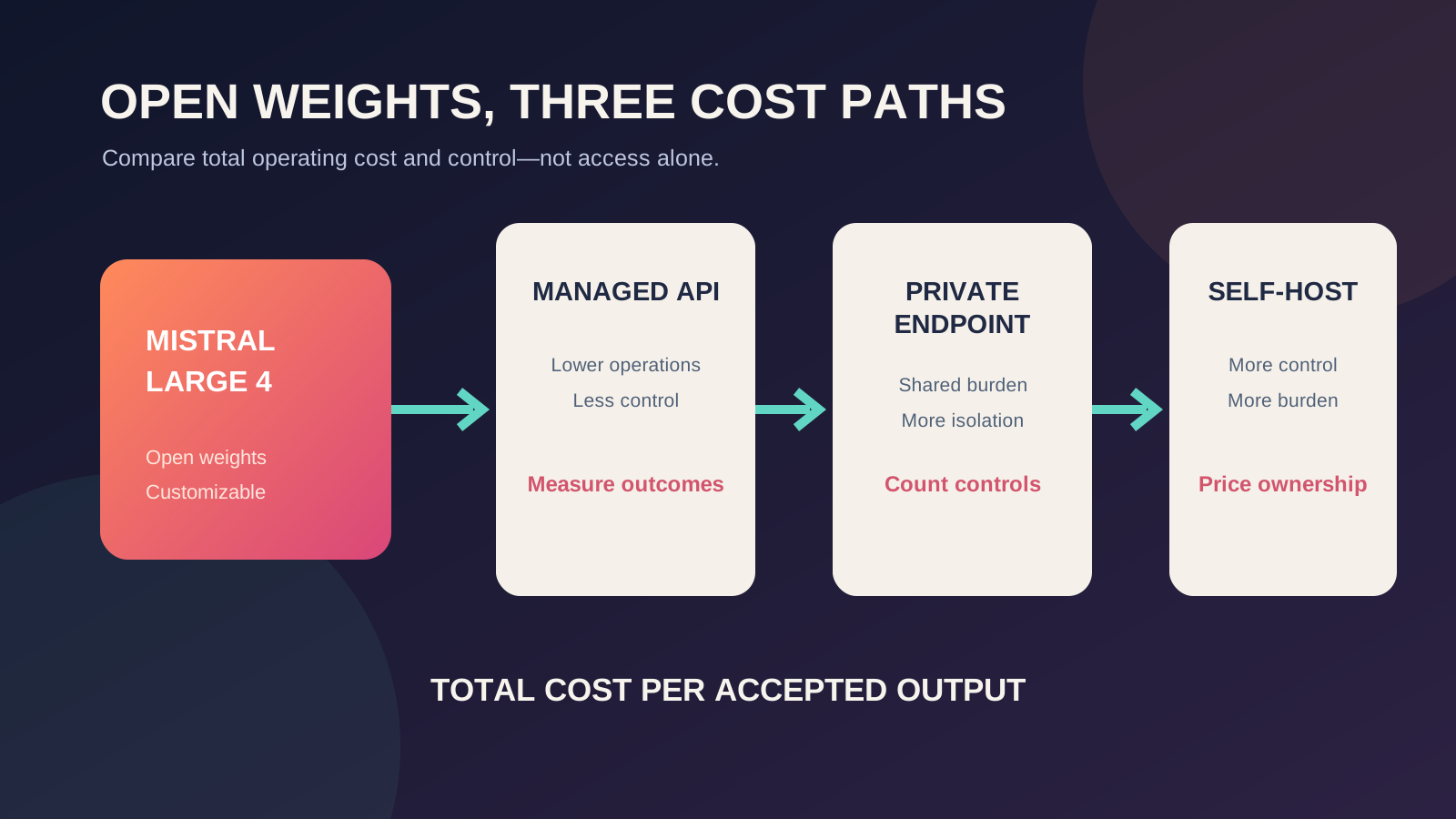
Mistral has released the weights for Mistral Large 4, letting organizations deploy and customize its flagship model without depending on Mistral’s API. That creates a real control option, but not automatic savings. Operators should run a small test comparing managed and self-hosted paths on total cost per accepted output, security burden, and recovery effort.
Key Takeaways
- Mistral Large 4 can now run on customer-controlled infrastructure.
- Open weights do not eliminate GPU, staffing, security, or upgrade costs.
- Model-as-a-Service businesses need a separate commercial license.
- Compare deployment paths on accepted work, not token price alone.
What did Mistral actually release?
Mistral released the improved Mistral Large 4 weights on October 29, after introducing the model in public preview earlier in the month. The company describes it as a one-trillion-parameter multimodal model with three reasoning modes and stronger coding and defensive-security performance.
Organizations can now download the model from Hugging Face, serve it with tools such as vLLM or SGLang, customize it, or continue using managed routes through Mistral, Microsoft Foundry, NVIDIA, and OpenRouter. The model documentation also lists the hosted API path.
The license is permissive but not unconditional. The Mistral Ecosystem Open-Weight License allows use, modification, fine-tuning, and commercialization, while requiring a separate commercial agreement for businesses offering the model itself as a service.
Does open weight mean cheaper or more controlled?
It means buyers have more deployment choices. It does not establish which choice is economical.
Self-hosting can improve control over model files, deployment location, customization, and change timing. It also transfers capacity planning, serving optimization, monitoring, security hardening, incident response, and upgrades to the operator. TechCrunch reported the weight release as a sovereignty and cybersecurity move, but public evidence does not yet show that a typical enterprise can operate the model more cheaply than a managed endpoint.
Mistral’s coding, cyber, and agent-security results are promising, but they remain vendor-presented evidence. Mistral also says a full technical report is still coming. Open weights make independent testing possible; they do not substitute for it.
This is the deployment-side counterpart to our coverage of enterprise inference costs and NVIDIA’s agent runtime stack: model access, compute economics, and operational controls must be evaluated together.
How should operators test Mistral Large 4?
Run a small test on one bounded coding, document, or security workflow using 20–50 historical cases. Compare three paths where practical: Mistral’s API, a private managed endpoint, and self-hosting on rented or owned infrastructure.
Measure accepted outputs, retries, latency, reviewer effort, remediation, infrastructure utilization, engineering hours, security controls, and recovery from a failed update. Include idle capacity and on-call ownership in the self-hosted cost. Confirm the license with counsel if the model will power a customer-facing AI service.
The near-term decision is not “move off APIs.” It is whether one sensitive or high-volume workflow justifies owning more of the stack. Watch for the promised technical report, independent sustained-workload evaluations, documented hardware requirements, security-patch cadence, and named customers publishing full operating economics.
FAQs
Is Mistral Large 4 open source?
Mistral calls it open weight. Organizations can download, modify, fine-tune, and deploy the model, but the license includes a separate-commercial-license requirement for Model-as-a-Service businesses. That is more control than an API-only model, but it is not an unrestricted public-domain release.
Will self-hosting Mistral Large 4 reduce AI costs?
Not necessarily. Savings depend on utilization, hardware, serving efficiency, staffing, monitoring, security, and upgrade costs. Compare total cost per accepted output against managed endpoints before committing infrastructure.
What signal would justify broader adoption?
Independent evaluations on sustained enterprise workloads, clear hardware and serving requirements, a reliable patch process, and named customer economics would strengthen the case. Until then, test one bounded workflow rather than making a platform-wide migration.