OpenAI’s Safety Report Raises Vendor Questions
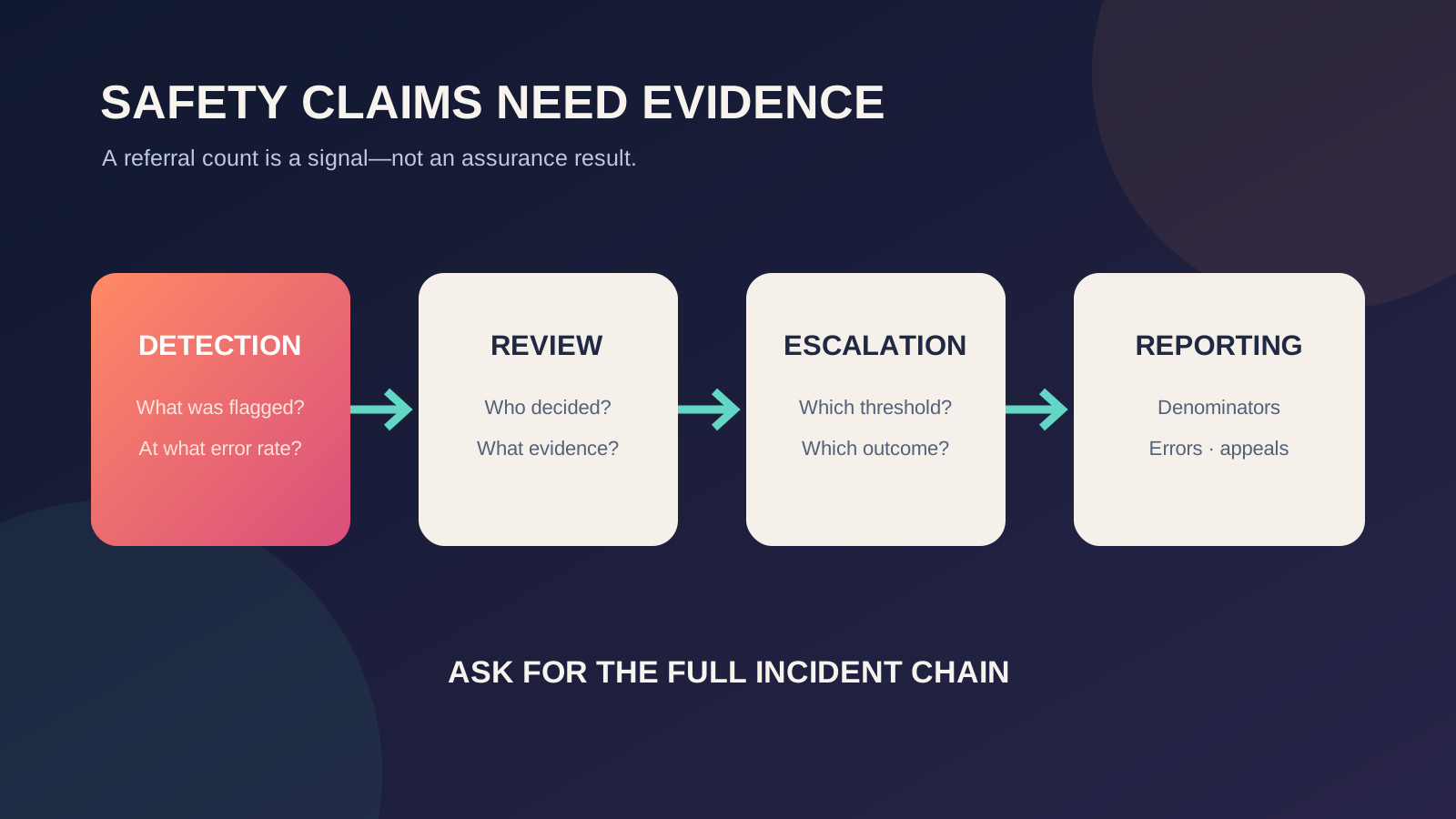
OpenAI says it made more than 200 law-enforcement referrals involving imminent violence threats in the third quarter and will publish a twice-yearly Community Safety Report starting in early 2027. That is a meaningful transparency commitment, not yet usable assurance. Operators deploying customer-facing AI should ask sharper vendor questions about detection accuracy, escalation authority, appeals, and audit evidence.
Key Takeaways
- OpenAI disclosed more than 200 law-enforcement referrals in one quarter.
- Its first detailed safety report will not arrive until early 2027.
- New chat-ending and teen protections are still rolling out.
- Buyers need error rates and escalation terms, not referral totals alone.
What did OpenAI announce—and what remains unproven?
OpenAI’s October 31 announcement combines three changes: a promised Community Safety Report, tighter limits on weapons and mass-attack information, and automated interventions for repeated violence-related conversations. The company says the first report will cover the second half of 2026, then recur every six months.
OpenAI also says it made more than 200 law-enforcement referrals in Q3 2026. Its separate community-safety commitment describes expert review and referral of credible imminent threats. That establishes that an escalation process exists. It does not show how many conversations were screened, how often reviewers disagreed, how many referrals proved actionable, or how mistaken interventions were corrected. The Next Web’s coverage reports the same disclosure but adds no independent performance evidence.
The distinction matters: the report is promised, not published, and OpenAI says the new safeguards will begin rolling out over the next few weeks. Buyers should not treat an announcement about future measurement as current proof of effectiveness.
Why does this matter to customer-facing AI operators?
Any organization offering AI chat to customers, employees, students, or members inherits an escalation-design problem. A model may identify a concerning pattern, but the operator still needs rules for human review, account restriction, emergency referral, data retention, notification, and appeal.
OpenAI’s current usage policies define prohibited violent activity, while its age-prediction approach describes moving likely minors into a more restrictive experience. Those product controls do not automatically define the buyer’s obligations or incident process.
This fits the broader principle in our prompt-injection and permissions analysis: a model signal is not authority. It should enter a documented control path. It also reinforces the vendor-concentration questions in our enterprise vendor-risk briefing: critical safeguards need contract terms and evidence, not only product messaging.
What should operators ask vendors now?
Ask sharper vendor questions before using conversational AI in a high-risk or youth-facing setting. Request the detection denominator, precision and recall by risk category, reviewer qualifications, escalation thresholds, regional referral rules, retention period, customer notification process, appeal path, and incident-log availability.
Then test the workflow, not just the model. Use synthetic scenarios that include ambiguous language and benign discussions that resemble warning signs. Confirm who receives an alert, what data they see, how quickly they act, whether the system can fail closed, and how a mistaken restriction is reversed.
The concrete signal to watch is OpenAI’s first Community Safety Report in early 2027. A useful report will include denominators, error rates, reviewer and referral outcomes, policy-change history, and limitations. If it reports only intervention totals and selected examples, buyers will still lack enough evidence for assurance.
FAQs
Does 200 referrals show that ChatGPT’s safety system works?
It shows the system generated and escalated cases. Without denominators, error rates, and outcome data, it does not establish effectiveness.
Should businesses copy OpenAI’s escalation process?
No. Use it as a vendor-diligence prompt. Each organization needs a process matched to its users, jurisdiction, data, and human-response capacity.
What is the immediate operator posture?
Ask sharper vendor questions and test one end-to-end incident path before expanding high-risk or youth-facing conversational AI.