OpenAI Cuts GPT-5.6 Sol API Prices 20% Through November
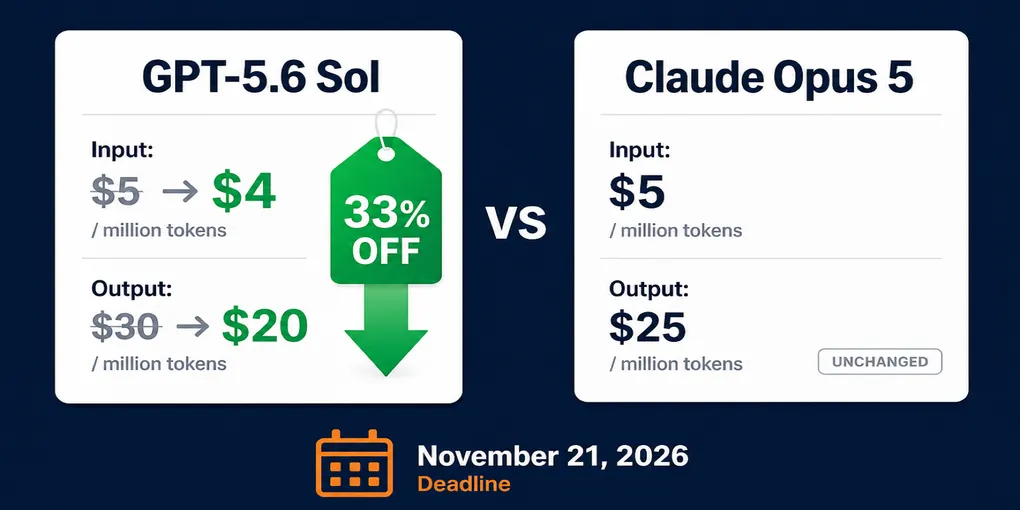
OpenAI announced on August 21 that it is cutting API pricing for GPT-5.6 Sol — its flagship model — by more than 20% on input and 33% on output. The new rate, now $4 per million input tokens and $20 per million output tokens on OpenAI’s developer pricing page, is labeled promotional by OpenAI’s rate card through at least November 21, 2026. At that rate, Sol is now cheaper per token than Claude Opus 5 ($5 input / $25 output). The cut covers the API, eligible ChatGPT Work credits, and Codex plans.
Key takeaways:
- New live rates: GPT-5.6 Sol is $4 input / $20 output per million tokens — a 20%-plus input cut and 33% output cut from its July 9 launch rate.
- Time-bounded: Promotional pricing runs through at least November 21, 2026. OpenAI has made no commitment about the post-November rate.
- Competitive shift: Sol at $4/$20 is now cheaper than Claude Opus 5 at $5/$25 on both input and output — OpenAI’s flagship model currently priced below Anthropic’s top-tier model.
- Pattern: This is OpenAI’s third GPT-5.6 pricing move in six weeks — Luna fell 80%, Terra fell 20% on July 30; Sol follows on August 21.
- Scope: Applies to API access, ChatGPT Work credit usage, and Codex plans. Consumer ChatGPT subscription pricing is unchanged.
Why Is OpenAI Cutting Its Best Model’s Price Now?
OpenAI’s stated rationale is ongoing efficiency improvement — the announcement says continued gains make lower prices possible. The competitive context is clearer. Claude Opus 5 at $5/$25 has been the pricing ceiling for high-capability models since Anthropic launched it. Sol at $4/$20 goes below that floor.
The pattern across six weeks tells the fuller story. Luna dropped 80% to $0.20/$1.20 and Terra dropped 20% to $2/$12 on July 30, leaving Sol at its launch rate. The August 21 cut completes the sweep — all three GPT-5.6 tiers repriced within weeks of general availability.
The “promotional” label is the most important word in the announcement. The November 21 deadline means operators treating $4/$20 as a baseline have roughly 90 days before the rate may revert.
What Should Operators Do Before November 21?
The most immediate question is routing. If your workflows send document analysis, contract review, or long-form generation to Claude Opus 5 because Sol was more expensive, that logic is now inverted. Sol’s output rate ($20) versus Opus 5’s output rate ($25) is a 20% reduction per million output tokens — where most inference cost accumulates in generation-heavy workloads.
Three actions for this window:
Benchmark your highest-cost task types. Run them against Sol at the new rate. The performance-per-dollar equation has shifted; routing logic that was optimal at the old price needs re-testing.
Do not restructure cost models around this rate. Model a reversion scenario before baking $4/$20 into multi-year automation economics.
Get pricing clarity in writing. Promotional prices belong in your contingency model; contractual rates belong in your agreements.
Operator posture: run a small test — benchmark Sol at the new rate against your current provider for your most token-heavy task. Route to it if the output quality holds. Do not re-architect. For context on how this fits the broader AI pricing war between vendors, see our earlier coverage.
What to Watch Next
- Whether OpenAI extends or makes the Sol rate permanent after November 21. A second extension signals a structural repricing; expiration signals promotional volume-grab.
- Anthropic’s response. Claude Opus 5 is Anthropic’s top-tier model — not mid-tier — and it now costs more per token than Sol on both dimensions. Watch for any Anthropic price adjustment or expanded ZDR and enterprise commitments as a signal of competitive response.
Frequently Asked Questions
Does this affect ChatGPT Business or Enterprise subscription pricing?
No. The promotional rate applies to token-based API usage, ChatGPT Work credit consumption, and Codex plans. Fixed-seat ChatGPT Business plans ($20/user/month) are not directly affected. Enterprise customers on credit-based billing should verify their rate card with OpenAI.
How does GPT-5.6 Sol now compare to Claude Opus 5 in cost?
At the promotional rate, Sol ($4 input / $20 output per million tokens) is cheaper than Claude Opus 5 ($5 input / $25 output) on both dimensions. Performance varies by task. Operators should benchmark their specific workloads before rerouting production traffic based on price alone.
What should operators plan for after November 21, 2026?
OpenAI has not stated what Sol pricing will be after the promotional window. Plan for both outcomes: the rate stays, or it reverts toward the pre-cut range. Do not lock multi-year automation cost projections into a promotional price without a written, contractual commitment to that rate.