A Shared AI Training Opt-Out Is Coming
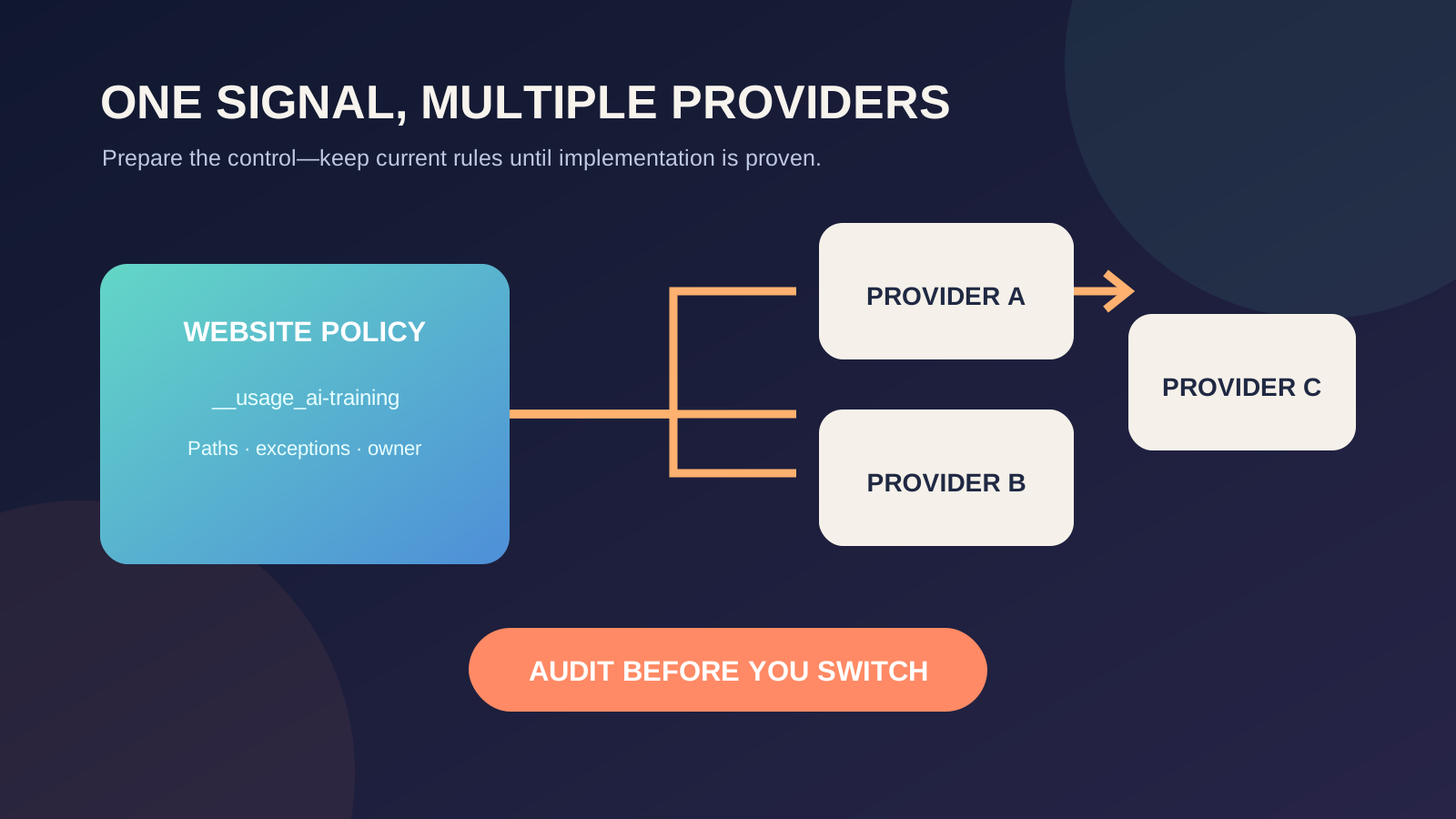
OpenAI and Google plan to honor one shared robots.txt signal for AI-training preferences, reducing the need to maintain vendor-by-vendor rules. The operator posture is prepare to adopt, not switch immediately: the mechanism remains a draft, implementation is future-dated, and current crawler controls still govern today.
Key Takeaways
- One policy token could express training preferences across participating AI providers.
- OpenAI says implementation will take months; Google targets 2027.
- Existing vendor-specific crawler rules remain active.
- Publishers should audit ownership, paths, and verification before changing controls.
What did the AI providers actually commit to?
OpenAI says it will honor the shared signal in the coming months while continuing to respect its existing controls. Google plans support in 2027 and says the new mechanism will coexist with Google-Extended.
The underlying machine-readable training preference proposal uses an ordinary robots.txt group with the policy token __usage_ai-training. A site could disallow training broadly while allowing a path such as a press kit. That is operationally cleaner than tracking every provider’s crawler name.
But this is an Internet-Draft dated October 30, not a finished standard or deployed control. OpenAI describes implementation as coming in future months; Google says 2027. Neither announcement proves that every AI provider will participate, interpret preferences identically, or provide compliance evidence.
Why should publishers avoid a quick configuration change?
Training preferences, crawling, and AI-search visibility are related but separate choices. OpenAI’s current crawler documentation distinguishes GPTBot, which concerns training, from OAI-SearchBot, which concerns search visibility. Google similarly says an explicit Google-Extended allowance can preserve eligibility for grounding in Gemini Apps even when a broader preference exists.
A rushed site-wide rule could therefore create an unintended discovery or licensing outcome. The broader IETF AI-preferences vocabulary is also still evolving, so operators should not turn one emerging signal into a complete content-rights policy.
This is the same control principle behind our agent-permissions analysis: a technical signal needs a named owner, an intended scope, and evidence that downstream systems honored it. It also belongs in the vendor-assurance process described in our enterprise vendor-risk briefing, rather than being treated as a one-time SEO edit.
What should website operators do now?
Prepare to adopt by inventorying current robots.txt groups, CDN or CMS overrides, vendor-specific crawler rules, and business owners for public content. Separate at least three decisions: model training, AI-search discovery, and licensed reuse.
Then stage the shared token in a non-production copy and test path precedence, especially exceptions for press, documentation, or partner content. Do not remove GPTBot, Google-Extended, or other existing rules until providers document implementation and your logs confirm the intended behavior.
The signal to watch is production support with precise precedence rules, implementation dates, test tools, and auditable provider behavior. Broad industry adoption would reduce maintenance. Until then, the shared token is a promising control-plane simplification—not verified enforcement.
FAQs
Does the shared signal block all AI crawling?
No. It expresses an AI-training preference. Search, user-triggered retrieval, and other crawling may use different controls.
Is the new token ready for production use?
Not as a replacement for current rules. It is an Internet-Draft, and announced vendor support is still forthcoming.
What is the immediate operator posture?
Prepare to adopt: audit current rules, assign ownership, test path exceptions, and wait for documented implementation evidence.