Verizon-AWS Deal Exposes AI's Network Dependency
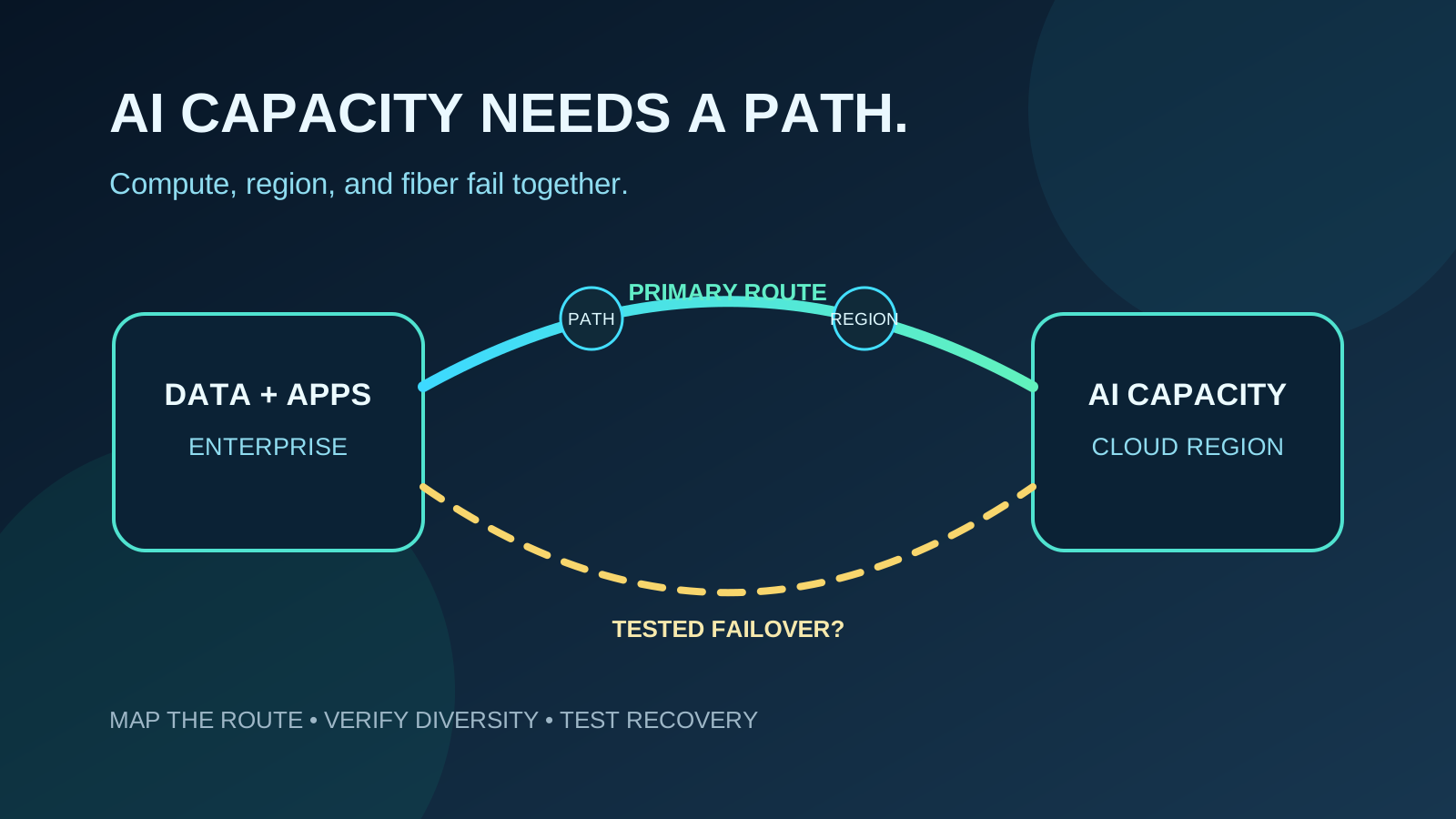
Reuters reports that Verizon’s high-capacity fiber agreement with Amazon Web Services is worth more than $2 billion. The important operator signal is not the contract size. This network dependency means AI capacity rests on long-haul routes as well as chips, power, and cloud regions. Buyers should ask sharper vendor questions about path diversity, delivery dates, and failover before treating reserved compute as available capacity.
Key Takeaways
- Reuters reports Verizon’s AWS AI-fiber agreement exceeds $2 billion.
- The underlying build was announced in November 2025.
- Reserved compute is unusable when the network path is late or fragile.
- Map network failover before expanding cloud AI commitments.
What did Verizon disclose about the AWS deal?
A Reuters report carried by CNBC says Verizon will provide high-capacity fiber connectivity for AWS data centers under an agreement worth more than $2 billion. The disclosure arrived with Verizon’s third-quarter results.
This is a valuation update, not a new deployment announcement. Verizon and AWS originally announced the build in November 2025, saying Verizon would construct new long-haul, high-capacity routes between AWS data-center locations. Neither the original announcement nor the earnings-day report provides route-level completion dates, committed bandwidth, pricing mechanics, or customer service levels.
The scale is still notable. Verizon also signed a multi-year, multi-billion-dollar fiber supply agreement with Corning in September 2026. Together, the disclosures show network construction becoming part of the AI capacity race rather than a background utility.
Why is network dependency now part of AI diligence?
An operator can reserve model throughput or accelerator capacity and still miss the business outcome if data cannot move reliably between users, applications, storage, and the selected region. The dependency appears as latency, transfer cost, delayed provisioning, constrained recovery, or a shared physical route that makes two “redundant” connections fail together.
That extends the continuity questions in our Anthropic capacity briefing and the capacity race described in our Big Tech AI infrastructure briefing. Cloud, network, power, and reserved compute should be mapped as one delivery chain, not approved in separate procurement files.
AWS’s own Direct Connect resilience guidance recommends dedicated connections in multiple locations for higher-resilience designs. That guidance does not prove Verizon’s new routes improve any buyer’s workload. It does provide a practical test: “multiple circuits” is not enough unless the operator knows the locations, carriers, physical paths, and failover behavior.
What should operators do now?
Ask sharper vendor questions before adding commitment. For one production AI workflow, draw the path from the user and source data to the cloud region, model endpoint, storage, and fallback. Record the carrier, connection location, region, promised capacity, delivery date, and owner for each dependency.
Then run a failover exercise during a low-risk window. Measure whether traffic actually changes path, whether identity and data controls remain intact, how latency and transfer charges change, and whether the alternate region has enough approved model capacity. Do not count a planned route as redundancy until it is commissioned and tested.
Watch next for route completion evidence, named availability zones, disclosed capacity, customer-facing service levels, and tested failover results. Until those appear, treat the $2 billion figure as evidence of infrastructure demand—not evidence that a specific enterprise workload is protected.
FAQs
Is Verizon’s AWS agreement new?
The fiber build was announced in November 2025. The new information is Reuters’ report that the agreement is worth more than $2 billion.
Does the deal improve AWS reliability for customers?
Possibly, but the public material does not establish an improvement for any named workload. Buyers still need route, location, capacity, and failover evidence.
What is the first question to ask a cloud vendor?
Ask which physical and regional dependencies support the promised AI capacity, which failures the design survives, and when the alternate path was last tested.