Sonnet 5 Pricing Is Now Permanent — Check Your Token Cost
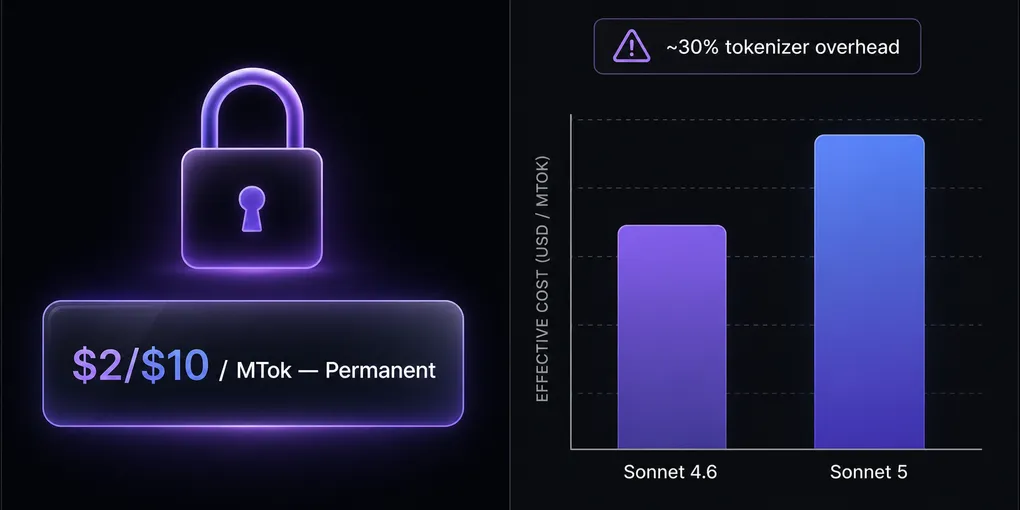
Anthropic’s official pricing documentation now lists Claude Sonnet 5 at $2 input / $10 output per million tokens — with an explicit note that the planned September 1 increase to $3/$15 will not occur. Secondary reporting places the announcement on August 10; Anthropic’s live pricing page confirms the rate is now permanent but does not independently state when the note was added. Either way, the September budget cliff teams had planned around is gone. That is genuinely useful news for cost planning. The complication: Sonnet 5’s new tokenizer produces roughly 30% more tokens for the same text, which can absorb a significant portion of the apparent rate-card savings in production workloads.
Key takeaways:
- Anthropic confirmed $2/$10 as Sonnet 5’s permanent API rate; the September 1 increase to $3/$15 is canceled.
- Sonnet 5’s new tokenizer generates approximately 30% more tokens per task than Sonnet 4.6’s tokenizer.
- Anthropic’s estimated 30% tokenizer overhead reduces the worked scenario’s apparent 33% savings to roughly 13% — benchmark your own workload to find your actual effective cost.
- On rate card alone, Sonnet 5 ($2/$10) is now half the price of OpenAI Sol ($4/$20) — but workload benchmarks matter more than rate cards.
- Priority Tier is not available on Sonnet 5 — a hard constraint for latency-sensitive production deployments.
What Did Anthropic Actually Change About Sonnet 5 Pricing?
Claude Sonnet 5 launched in June 2026 at $2/$10 per million tokens, explicitly labeled introductory with an August 31 sunset. Teams building cost models around Sonnet 5 had a September cliff to plan for: the rate was scheduled to rise 50% to $3/$15 — matching Sonnet 4.6’s current price — on September 1.
According to secondary reporting, Anthropic confirmed the cancellation in early August. The official pricing page now states: “The $2/$10 per million input/output token pricing for Claude Sonnet 5, announced at launch as introductory pricing through August 31, 2026, is now the standard price. The previously scheduled increase to $3/$15 per million input/output tokens on September 1, 2026 will not occur.”
For any team already running Sonnet 5 in production, this is a clean win — no bill shock, no migration, no September urgency. For teams evaluating whether to adopt Sonnet 5, the permanence removes a key uncertainty from the build-or-wait calculation. But the rate card is not the full picture.
Does $2/$10 Actually Beat $3/$15 in Practice?
The catch is Sonnet 5’s new tokenizer. Anthropic’s pricing documentation states: “Claude 4.7 and later models use a newer tokenizer that produces approximately 30% more tokens for the same text.” That figure is Anthropic’s own stated estimate — actual overhead varies by content type and prompt structure; independent workload benchmarks are not available.
Run the math on a representative production workload — say 100 million input tokens and 20 million output tokens per month:
- Sonnet 4.6 at $3/$15: $300 input + $300 output = $600/month
- Sonnet 5 at $2/$10 with 30% tokenizer overhead: 130M input × $2 + 26M output × $10 = $260 + $260 = $520/month
That is roughly 13% savings — real, but substantially less than the 33% the rate card implies. As CloudZero notes, the $2 input tier is now “the most contested price point in AI.” For context, OpenAI’s Sol is priced at $4/$20 through November 21 on a promotional basis, making Sonnet 5 the lower-cost option on rate card alone. Why Anthropic made the pricing permanent is not stated in official documentation; the competitive framing is AdvancedAI’s contextual interpretation.
One hard operational constraint worth flagging: Priority Tier is not available on Sonnet 5. Teams that relied on Priority Tier latency guarantees on Sonnet 4.6 cannot simply upgrade — they’ll need to evaluate whether standard tier latency is acceptable for their use case.
What to Watch Next
Watch whether the $2/$10 rate applies to your specific billing context. “Permanent” in Anthropic’s documentation refers to the Claude API rate billed directly by Anthropic. If you access Claude through Amazon Bedrock, Google Cloud Vertex AI, or another cloud platform, verify your effective rate in your provider’s current Claude pricing documentation — the Anthropic API rate is not necessarily what you are billed through a cloud provider.
Also watch OpenAI’s November 21 Sol decision. If Sol’s $4/$20 promotional rate becomes permanent or drops, the mid-tier pricing comparison shifts again. If it reverts upward, Sonnet 5’s permanent rate becomes the clearer cost anchor for Anthropic-native workflows.
For most operators, the near-term move is not to re-architect around this announcement. It is to benchmark your actual token consumption on Sonnet 5, then decide whether the effective cost — not the rate card cost — makes the upgrade worthwhile. The permanent pricing removes the September urgency; the tokenizer overhead is the variable only your workload can resolve.
FAQ
Does Anthropic’s Sonnet 5 permanent pricing apply to Amazon Bedrock and Google Cloud?
The permanent rate applies to the Claude API billed directly by Anthropic. If you access Claude through Amazon Bedrock, Google Cloud Vertex AI, or another cloud platform, check your provider’s current Claude pricing page directly — your billed rate may differ from the Anthropic API rate. The Anthropic API rate is your starting reference point, not necessarily your actual billed cost.
If Sonnet 5 uses 30% more tokens, is it still cheaper than Sonnet 4.6?
Using Anthropic’s stated 30% overhead estimate, yes — but by less than the rate card implies. At a flat 30% tokenizer overhead, Sonnet 5’s effective input cost per task comes to roughly $2.60/MTok equivalent versus Sonnet 4.6’s $3.00/MTok — about 13% savings on input, similar on output. Anthropic’s 30% is its own estimate; actual overhead varies by workload. Benchmark before budgeting.
Is “permanent” a contractual pricing guarantee from Anthropic?
No. Anthropic’s pricing documentation confirms the scheduled September 1 increase was canceled and the $2/$10 rate is now listed without a planned expiration date, but the documentation page itself is not a contractual price lock. Whether and how Anthropic can adjust pricing depends on your specific contract — the public pricing page does not address that. Enterprise customers and those with volume commitments should review their contract terms to understand their actual pricing protections.