Claude’s ROI Reports Need an Independent Check
Anthropic has made smart reports, in-app surveys, and pooled team budgets generally available for Claude Enterprise. The tools can show where usage and spend concentrate, what employees say is valuable, and where workflows break. That is useful operational evidence—but not independent proof of return on investment. Operators should run a small test and reconcile the dashboard with accepted work and business outcomes.
Key Takeaways
- Claude can group sampled team transcripts into workstreams and costs.
- Employee surveys add context, not objective productivity proof.
- Pooled budgets improve allocation but can accelerate unverified spending.
- Reconcile vendor reports with accepted work before expanding budgets.
What did Anthropic make generally available?
Anthropic says three Claude Enterprise features are now generally available. Smart reports analyze a sample of team transcripts, group activity into workstreams and deliverable types, attach list-price spend, identify friction, and recommend reusable skills or rules.
The underlying smart-report documentation says admins can scope a report to a team, products, and up to the previous 28 days. Reports can surface expensive sessions, unusable outputs, tool failures, rework loops, and work Anthropic classifies as complex or autonomous.
Anthropic also added in-product surveys, whose exports can include each respondent’s email, group, answers, and product surface. Pooled group budgets let teams share a monthly allowance while retaining individual limits; a user stops when either applicable limit is exhausted.
Why are Claude ROI reports not independent proof?
The report can locate cost and friction faster than a raw usage log. But Claude is interpreting sampled Claude conversations, and employee surveys capture perceived value. Neither establishes that a deliverable was accepted, avoided rework, shortened cycle time, raised revenue, or reduced risk.
That distinction matters because the same product is measuring the activity, classifying the output, and recommending more product use. TechCrunch frames the release as Anthropic’s attempt to demonstrate value. The reports may be informative without being independent.
This is the next step beyond basic spend controls. Our briefings on enterprise agent costs and OpenAI spend controls made the first problem visible: consumption can rise faster than budgets. Smart reports address where spend went, but operators still need to determine what the spend bought.
How should operators test the reports?
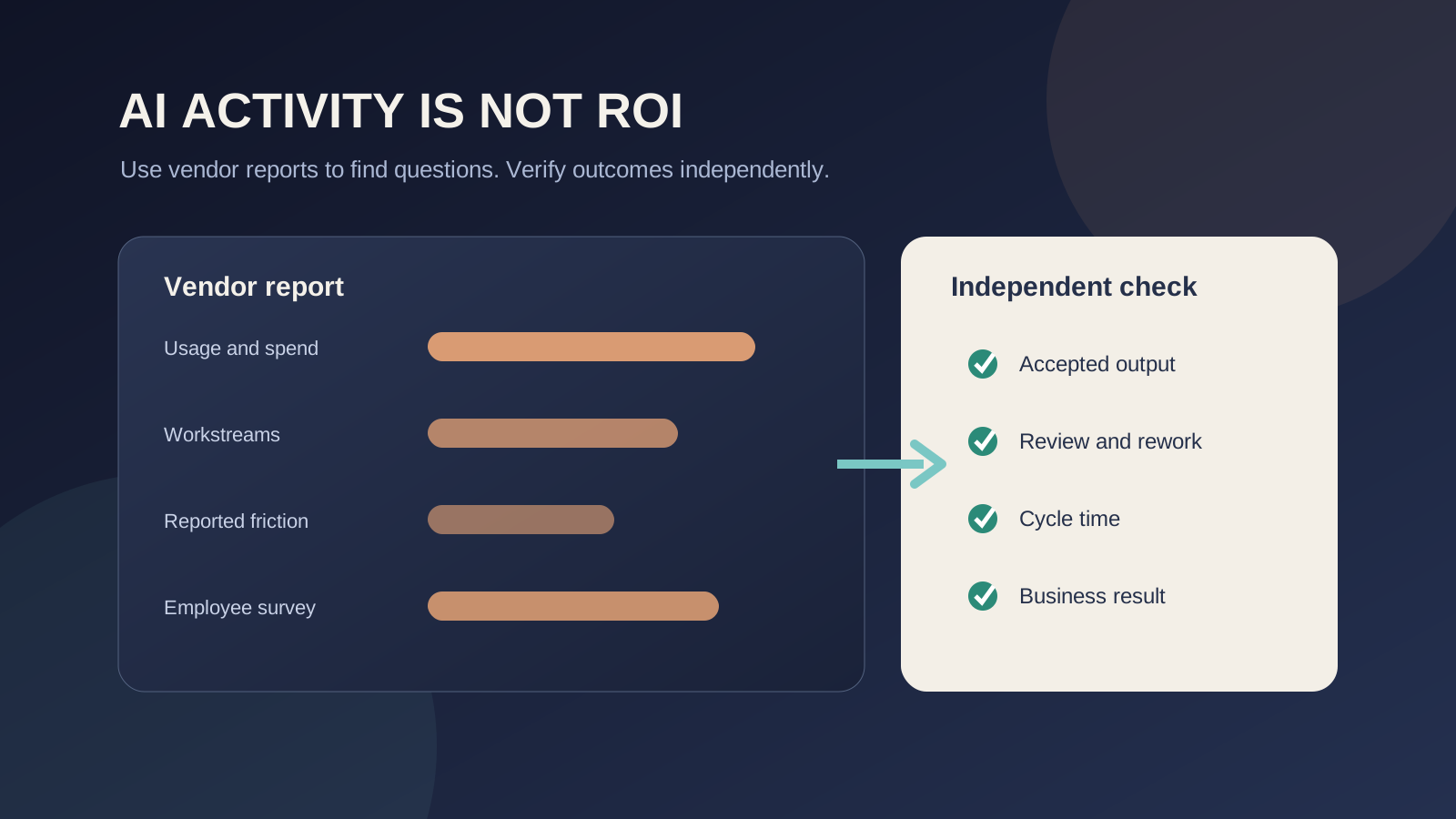
Run a small test with one team and one recurring workflow for 30 days. Before opening the report, define accepted-output criteria and record baseline cycle time, human review, rework, error remediation, and business result. Then compare Claude’s workstream, cost, friction, and time-saved classifications with finance records and a sample reviewed by the workflow owner.
Use the report to find questions, not settle them. Ask whether expensive sessions produced accepted work, whether low-cost sessions shifted effort to reviewers, whether survey responses match observed outcomes, and whether raising a pooled budget improves throughput rather than activity.
Watch next for reproducible report results, event-level exports or APIs, clearer audit trails for classifications, privacy controls by role and data type, and named customers reconciling vendor reports with operational and financial records. Until then, use smart reports for diagnosis and budget triage—not as the ROI scorecard presented to the board.
FAQs
Are Claude smart reports independent audits?
No. Claude analyzes sampled Claude transcripts and applies Anthropic’s classifications. The reports can identify patterns worth investigating, but operators should validate them against accepted outputs, labor, rework, and business results.
Should operators enable pooled budgets immediately?
Only after reviewing actual team spend and setting individual guardrails. A shared pool can reduce wasted allocation, but it can also let high usage expand before value is verified.
What should a 30-day test measure?
Track accepted outputs, cycle time, reviewer effort, rework, error remediation, total spend, and the business result. Compare those measures with the report’s workstreams, costs, friction, and recommendations.