Gemini 4 Argon Has a December Cost Cliff
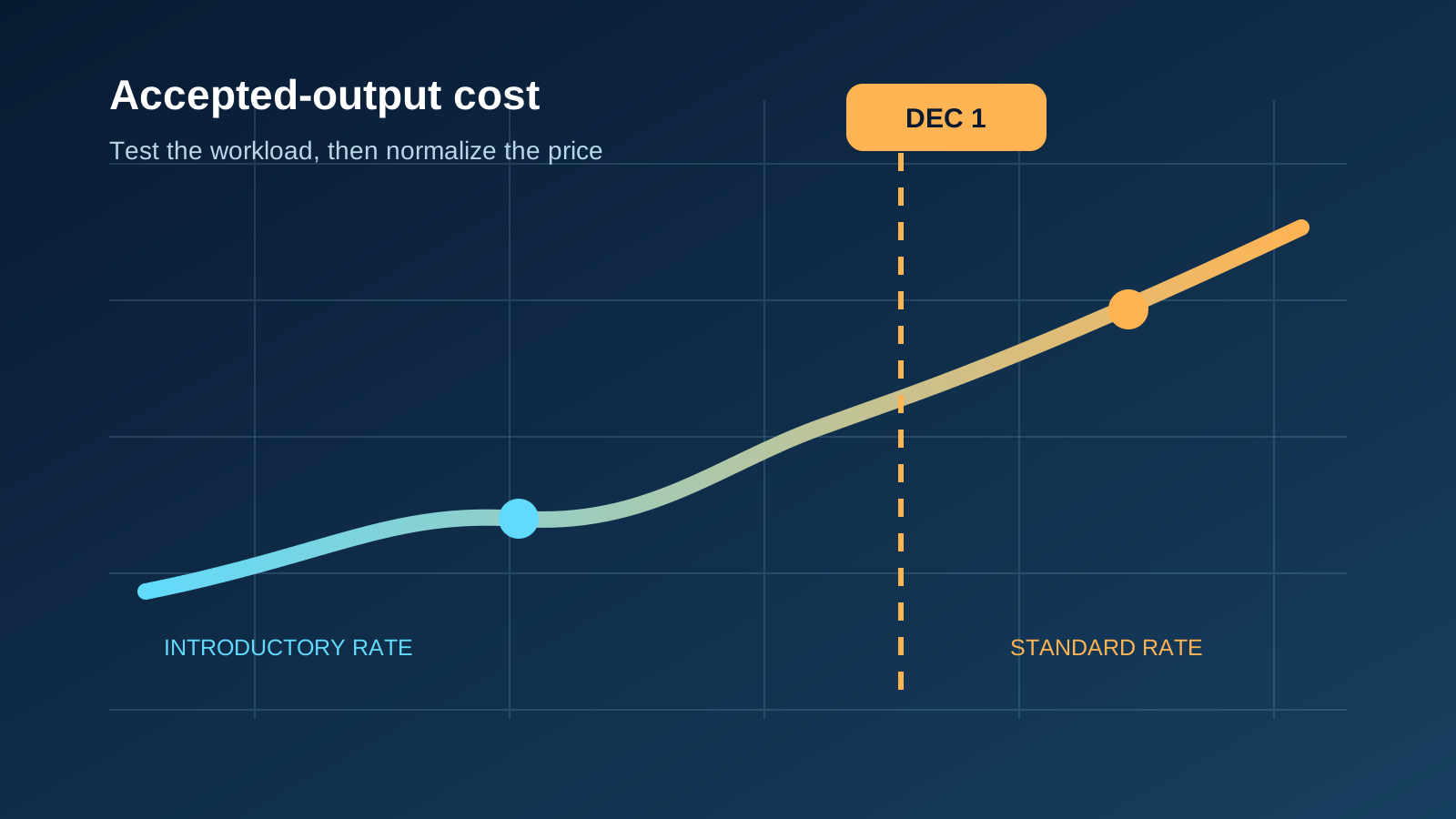
Google has made Gemini 4 Argon broadly available with unusually long generation and discounted API rates through November 30. For operators, the decision is not whether Argon wins a benchmark. It is whether long, reasoning-heavy work produces more accepted outputs before its input and output rates double in December.
Key Takeaways
- Argon is available through Google’s paid API and enterprise platforms.
- Input, thinking, and output share one 1,048,576-token budget.
- Introductory $2/$10 rates double after November 30.
- Operator posture: run a small test normalized to December pricing.
What did Google actually make available?
Google’s Cloud launch notice says Argon is available to enterprise developers through the Gemini platform and related Google products. The developer guide lists the API model as gemini-4-argon and describes long decode, tool use, coding, and complex reasoning.
The important implementation detail is the token budget. Google’s token documentation says input, internal thinking, and output share one 1,048,576-token window. A large prompt therefore leaves less room for reasoning and response. Standard synchronous output is capped at 65,536 tokens unless a team deliberately configures long decode.
Availability is not deployment proof. Google’s model card reports capability and safety evaluations, while the launch post cites early customer results. Those are useful test inputs, not evidence that Argon will complete a buyer’s workflow more cheaply or reliably.
Why does the December price matter now?
Google’s API pricing page lists introductory rates of $2 per million input tokens, $0.10 per million cached input tokens, and $10 per million output tokens through November 30. Standard rates then rise to $4, $0.20, and $20 respectively.
That creates a procurement trap: a November pilot can appear economical even if identical December usage would not. Long decode can amplify the error because output and thinking consumption may dominate total cost. Teams should also include retries, tool calls, latency, reviewer time, and rejected answers—not just token charges.
The same accepted-output discipline applies to GPT-6.1 Sol testing and enterprise agent spending controls. A low launch rate is a temporary input to the model-routing decision, not the decision itself.
How should an operator test Argon?
Run a small test on 20–50 difficult but low-risk tasks with known acceptance criteria. Compare Argon against the incumbent using identical instructions, tools, permissions, and review rules. Track accepted outputs, retries, input, thinking and output tokens, elapsed time, reviewer minutes, corrections, and fallback failures.
Calculate every result twice: once at introductory rates and once at the December rates. Include short-context tasks and genuinely long-context work so the shared token window is tested rather than assumed. Keep consequential writes and customer-facing output outside the pilot.
Watch next for independent sustained-workload results, request-level cost visibility, production reliability evidence, and named customer outcomes measured after promotional pricing ends.
FAQs
Should businesses switch to Gemini 4 Argon now?
Not broadly. Test the workloads where deeper reasoning or longer generation could improve acceptance enough to offset higher December rates and review costs.
Does a one-million-token window mean one million input tokens?
No. Google says input, thinking, and output share the same 1,048,576-token budget. A larger prompt reduces the remaining reasoning and response capacity.
Are the launch prices permanent?
No. Google says the introductory API rates end November 30, 2026. Normalize pilot economics to the published December rates before changing production routes.