ChatGPT Ads Cross $1B — Is Your Team Ad-Supported?
OpenAI announced on August 31 that ChatGPT Ads had crossed $1 billion in annualized revenue run rate in under 200 days from its February 2026 US launch. Self-serve ad access expanded to India, Europe, the Middle East, and North Africa at the same time. For operators, the revenue milestone matters less than what it reveals about the tier split — and which of your employees sit on which side of it.
Key Takeaways
- ChatGPT Ads is live in 40+ countries; self-serve Ads Manager now available in India, Europe, the Middle East, and North Africa.
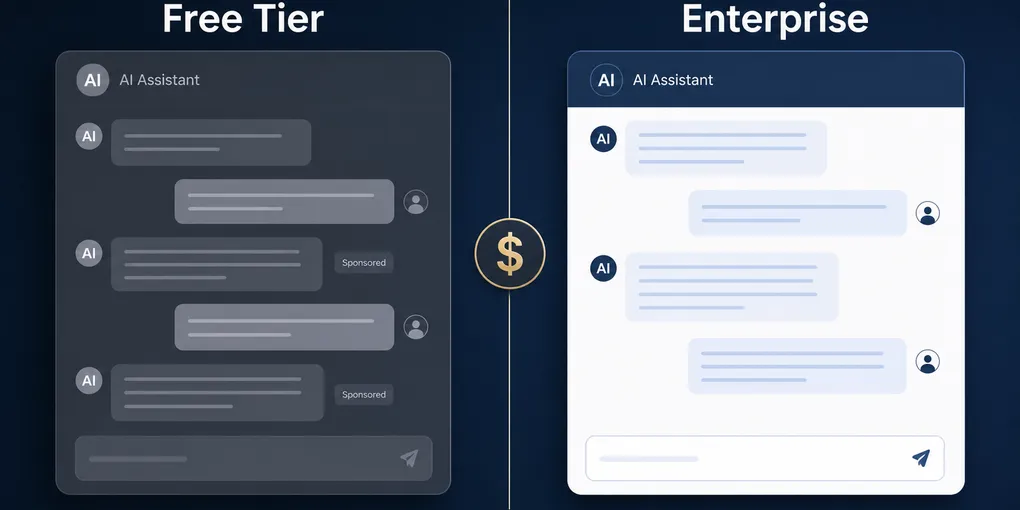
- Free and Go tiers see contextual ads; Plus, Pro, Business, Enterprise, and Education tiers do not.
- On Free and Go tiers, conversation content is used to determine which ad appears — that specific use does not apply on Plus, Pro, Business, Enterprise, or Education plans.
- ChatGPT Ads Manager is a self-serve performance channel worth evaluating for B2C and SME-facing businesses.
- OpenAI reported $6.7B in Q2 2026 revenue; advertising is a fast-growing but secondary line at this stage.
What Does the Ad-Supported Tier Actually Mean for Your Team?
The split is explicit: Free and Go are the ad-supported tiers; Plus, Pro, Business, Enterprise, and Education are ad-free. OpenAI confirms more than 1 billion weekly active users on ChatGPT. Free and Go are the default entry-point tiers. Employees using Free or Go accounts are in the ad-supported product; those on Plus, Pro, Business, Enterprise, or Education plans are not — regardless of whether that account is personal or employer-managed. CNBC’s reporting covers the expansion in full.
If those sessions involve work tasks — common in organizations that haven’t standardized AI access — they occur inside an ad-supported product. OpenAI states that advertising does not influence ChatGPT’s answers and that advertisers do not access private conversations. The documented data-use difference is narrower than a broad privacy concern: on Free and Go tiers, the content of the current conversation is used to determine which ad appears. That specific use does not apply on Plus, Pro, Business, Enterprise, or Education plans. It is also separate from OpenAI’s data training and retention policies, which operate under their own terms. Most AI acceptable-use policies have not yet drawn this line explicitly.
This is not an emergency. Free or Go ChatGPT for general research or low-sensitivity drafting carries manageable risk. The concern is confidential data entering those sessions — a problem that predates advertising, with ads now adding one more documented reason to act.
Operator action: Audit which employees use personal ChatGPT (Free or Go) for work. Update your AI acceptable-use policy to explicitly distinguish ad-supported tiers (Free or Go) from company-provisioned enterprise AI.
Should You Test ChatGPT as an Ad Channel?
The advertising expansion opens a new performance channel. ChatGPT Ads Manager has been self-serve for US small and medium businesses since May; that access now extends globally.
Business Insider reports the platform has tens of thousands of advertisers. OpenAI cites one client with more than 3× return on ad spend in 28 days, and another where 80% of traffic came from new customers — both are OpenAI-selected examples and should not be treated as independent benchmarks. CPC and outcome-optimized bidding are available, alongside Pixel and Conversions API for measurement.
The structural argument for testing: ChatGPT users are often mid-decision — researching a product, planning a purchase, comparing vendors. Contextual placement at that moment differs from banner or social ads. Whether it converts at scale for your category requires a controlled test.
Operator action: If you serve consumers or small businesses in any of the 40+ eligible markets, add ChatGPT Ads to Q4 channel evaluation. Set a controlled budget and define measurable success criteria before launch.
What to Watch Next
Watch for any change to tier or data-use policy — if OpenAI introduces advertising to Business or Enterprise tiers, currently ad-free, that would be a significant shift. Enterprise buyers with upcoming contract renewals should ask how their data-use terms interact with the ad system’s data flows, even though their accounts are currently excluded. For channel investment, the near-term signal is independent measurement: OpenAI’s ROAS examples are self-selected early cases; third-party performance benchmarks, when available, are the more reliable input for sustained investment. OpenAI’s IPO-track developments are relevant context for enterprise buyers modeling the company’s revenue incentives over the next 12–18 months.
FAQ
Do Business and Enterprise ChatGPT accounts show ads?
No. OpenAI explicitly excludes Plus, Pro, Business, Enterprise, and Education tiers from advertising. If your organization has provisioned ChatGPT through a Business or Enterprise agreement, employee sessions do not include ads. The governance concern applies to employees using personal Free or Go accounts for work tasks.
How does OpenAI target ads inside ChatGPT?
OpenAI uses the content of the current conversation to determine which ad is relevant; depending on user settings and country, it may also reference broader ChatGPT history. Advertisers do not receive access to private conversation content. OpenAI states that ads do not influence ChatGPT’s answers, and all ads are labeled separately from ChatGPT’s responses.
Should we ban free ChatGPT use at work?
A blanket ban is rarely the right starting point. The more useful question is what data classification applies to the task. General research and low-sensitivity drafting carry manageable risk. If employees are sharing confidential information in free ChatGPT sessions, that gap should be closed — advertising adds one more documented reason to address it now.